

The Pashmina Route - Story | Road trip from Manali to Srinagar via Zanskar & Kargil | Old Silk Route Road of India | History of India | Indian History
- kanupriya raniwala
- 2 days ago
- 9 min read

#Silkroute #Silkrouteofindia #roadtriptoladakh #Manalitokashmir #manalitokashmirbyroad #Ladakhcircuit #zanskarfixeddeparture #ladakhfixeddeparture #thingstodoinmanali

"If there's one thread, quite literally, that ties these four places together, it's wool. Not folklore, not religion, but the Old Silk Route trade. A goat in Tibet grew it, only a trader in Ladakh could buy it, a merchant in Kargil housed it, and a weaver in Srinagar spent a year and a half turning it into something you could fold into your palm today, brought to you through treacherous passes like Rohtang.... This is not a Ladakh trip! This is not a Kashmir trip! This is not about Monasteries!
It is about understanding the history of India by physically travelling on one of the Silk Trade roads that shaped it. "

Hi, I'm Kanupriya. Trained as an architect, but somewhere along the way I realized I was far more interested in why a place was built the way it was than in building anything new myself. So, i let go of the drafting table and got behind the wheel to live history, topography and culture first hand in the various Himalayan regions i have lived in since 13 years. Which got me knee deep in the trade & food history of the Indosphere & The Old Silk Route! Making this a principal for my work, I've spent years curating experiential journeys for people who want to travel a little deeper than the postcard.
I live in Manali now, right at the gateway of the Trans-Himalayas, where it all began and my feet itch yet again to be there. So lets go back in time and retrace the yak caravans once took days to cross, carrying wool and salt and stories between kingdoms that don't exist by names anymore. I long to be there always, and this time my heart insists: to take you with me.
So I am. Let's go. But Why Nerd Over the Silk Route? - People Ask Me
Because everything we call “home” today, our food, our faith, our fabric, even the roads we drive to satisfy the adrenaline rush, was shaped by people who were, at some point, just trying to sell something to someone very far away. Long before flights and highways, trade was the internet of the ancient world.

And in the middle of it all, sat India / Indosphere. Not on the edge of the map, at the center of it - as a prominent passage of the Silk Route in the North. Ships came for our textiles and spices, caravans came down from Central Asia for our grain and craftsmanship. We were rich, curious, and unusually well-connected, bound by water on three sides, stitched to the rest of Asia by mountain passes on the fourth. Everyone wanted a piece of us, a way in, and because of that, this land didn't just receive the world, it shaped how the world thought, worshipped, dressed, and did business for centuries! Most people imagine the Silk Route as a ribbon stretching across China, Central Asia and Europe. Few realize that one of its most remarkable branches crossed the Indian Himalayas, linking Manali, Lahaul, Zanskar, Ladakh and Kashmir.
So i kept nerding! - to understand who we are today, you have to stand on the roads that made us. Not read about them. Stand on them. This has been the principal behind my work! So i chose one of the most intriguing, jaw dropping, culturally rich and heritage jaded route for us!
And that's what this is. Not a history lesson, I promise. A journey.
Did you know - The Indosphere stretched uptil Kashgar back in the day?

Checkout the whole map here Three States, One Road: Meet the Pashmina Route
Here's the route we're travelling together: Manali to Zanskar to Kargil to Srinagar. 4 Regions, Three states and union territories, one continuous corridor, and for centuries, one unbroken conversation between people who never should have met, and did anyway.
I like to call it the Pashmina Route, because if there's one thread, quite literally, that ties these four places together, it's wool. Not folklore, not religion, but Old Silk Route trade. A goat in Tibet grew it, a trader in Ladakh is legally the only person who could buy it, a merchant in Kargil housed it for the night, and a weaver in Srinagar spent a year and a half turning it into something you could fold into your palm, carried via treacherous passes like Rohtang.
Four stops. Four focal points of Cultural, Religious, Culinary, Art & Architecture exchange. No only did items of daily use travelled through these points, but also did education, religions, recipes, art and dialects. The shear want of Pashmina shaped it all!

Kullu -Manali — Gateway to the Trans-Himalayas
Honestly history hasn't changed a bit. Strolling on the Mall Road, I still see Manali from the centuries ago, as the first green wooded oasis for the weary traders & herdsmen coming from the unforgiving high altitude deserts of Central Asia. Manali, always served as the stop for travelers / traders passing through, either going up or down. It has seen it all, from herd s of yaks and sheep crossing over Hampta for Spiti & Lahaul to the present day trekker who signs up for a 4 day trekking expedition as an escape from Indian Tropical summer. Manali has served everyone!
“Kullu” earlier known as Kulanthapitha, meant “the end of the habitable world.” Not dramatic for effect, that's genuinely how it was thought of, the last stop before the air got thin and the mountains turned serious.

Beyond this last wooded village, were the treacherous passes, glaciers and emerald blue lakes whose marshes attracted the 'gaddis' (shepherds) of Kullu. So when you see a sheep jam on the roads of Manali in summer, know that these herds are heading towards the richest grasslands for the best wool! Which back in the day was traded for Himalayan salts, gems and stones.
Did you know: there was once an actual customs post at the base of Rohtang, at a spot called Rahla, where an officer of the Kullu rajas weighed every sack of salt and grain coming through and took his cut. Your toll booth on the highway today? Not a new idea, just a very old one wearing a barrier gate.
Today, this is where I live: cafés instead of caravanserais, backpackers instead of traders, but the same restless energy of a place people pass through on their way to somewhere bigger. Manali has seen it all!
This is the gate to the Trans Himalayas. Let's cruise through it.

Zanskar — The Land In Between
Cross Rohtang, drop into Lahaul, climb again over the Shingo La, and you fall into a world that's been quietly keeping its own secrets for a thousand years. Zanskar doesn't announce itself. It just appears: stark, silent, stubbornly beautiful. From lush green forests of Himachal to the cold rolling deserts of the Himalayan belt through unimaginable passes, existence sometimes became questionable.
The name itself is a small mystery. Everyone agrees on the first half, Zangs, meaning copper. The second half Kar is disputed: white copper, copper palace, copper star, or, my favourite, “food palace”, a nod to a valley that could grow enough to sustain itself in a landscape that seems to sustain nothing.
Sitting between Lahaul, Ladakh & Kargil, Zanskar became luring enough for all 3 kingdoms to wage wars on the Kings of Zangla, Zanskar. Finally Zanskar became a part of Ladakh after the Namgyals took over in the 11th century.

Here's the part I love most. A guild of just eight families, based out of Leh, held a royal permission slip no one else in the region had: they were the only people legally allowed to buy raw wool directly from western Tibet. Tax-exempt, trusted by kings, carrying the most valuable cargo on this road through some of the least forgiving terrain on earth.
Did you know: this wasn't a gentleman's agreement, it was written into an actual treaty in 1684, and renewed again in 1842. Two kingdoms, formally agreeing on who gets to touch a goat's wool first. I never aw wool the same way as before after knowing this!
Monasteries like Karsha and Phugtal sit through all of this almost untouched by the wealth passing so close to them: cliffside, remote, more interested in silence than in silk. That contrast is what makes Zanskar magnetic.
Homestays here now sit in villages the traders once passed through without stopping. Stay a night. You'll understand the silence I keep failing to describe.

Kargil — The Crossroads of Trade
If Manali is the gate and Zanskar is the quiet middle, Kargil is where the real noise happened.
Most people know Kargil for the Indian victory over Pakistan in the 1999 war and hence the Drass War Memorial (which indeed humbles you) but did you know Kargil's name comes from the Balti words for “a stopping place reachable from everywhere”, an accurate job description four hundred years running when the borders were arbitrary. There's an old saying about this town: all roads lead to Kargil. And they genuinely did, it sat almost exactly equidistant from Kashmir, Baltistan, Zanskar and Leh. Even today when you walk through the bazaar of Kargil, you will find yourself in a mini Central Asia, like a living museum with faces and features from all ethnicities!
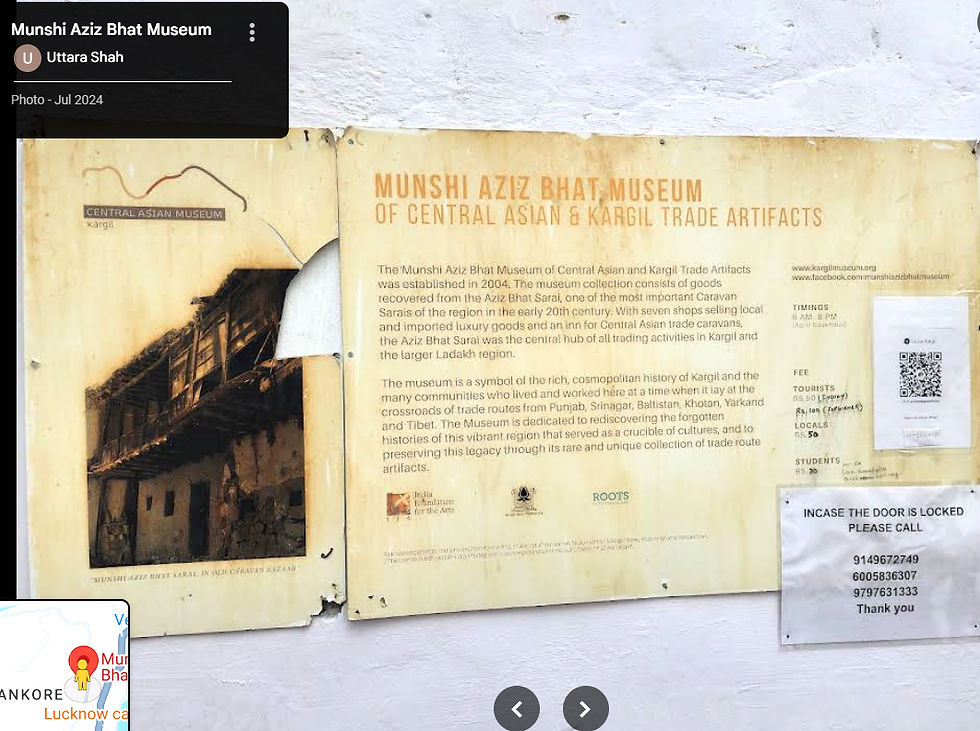
Here's my favorite true story on this road: in 1920, a merchant named Munshi Aziz Bhat built a caravanserai here called the Ek Sarai, “one guesthouse.” It could hold four to five hundred caravans' worth of horses, camels, goods and traders at once, animals stabled below, goods on the ground floor, merchants sleeping above. His firm dealt in everything from European soap to Central Asian carpets and horse tack. Imagine that room: Yarkandi merchants, Kashmiri shawl traders, Punjabi wholesalers and Ladakhi wool guilds, all under one roof, all trying to strike a deal before morning.
That building still stands. You can walk into it today, a museum now, holding around a thousand original trade artefacts, one of the most underrated places on this entire road.
The route from Zanskar to Kargil is by far the most beautiful highways i have driven on! Studded with glacial lakes at Pensila, crossing a 23 km long feeder glacier, witnessing the ultimate orientation of Rangdum moanstery, entering in Suru Valley is just surreal.
Suru valley just outside town grows some of the sweetest apricots you'll ever eat, a small, sunny contradiction in a district otherwise defined by high, stark passes. Have some. You've earned it.
There is so much more to Why & How, which you might know once you join our caravan!

Srinagar — The City of Wealth and Prosperity
Every road has to end somewhere, and this one ends where it was always headed: in a city whose very name is a promise. And every time i have driven from Kargil to Srinagar, experiencing contrast in landscape, culture, attires, language in just a few days makes one wonder what really human kind was upto then. Crossing over Zozila and Sonmarg we reach Srinagar.
Srinagar, from the Sanskrit Sri (wealth, prosperity) and nagar (city), literally, “the city of wealth.” Not a marketing name someone invented later, that's what it's been called for over a thousand years, and once you've followed this road here, the name makes sense.

This is where the wool's journey ends. That raw pashm, combed off a goat in western Tibet, carried by the palace traders of Leh, housed for a night in Munshi Aziz Bhat's caravanserai, arrives here and becomes something else entirely. In workshops around Zaina Kadal, the oldest trading quarter, built around a 1427 bridge, and Maharaj Gunj, the great 19th-century wholesale market, weavers would spend up to two years on a single elaborate shawl. Two years, for something you could fold into one hand. And hence, every household on this planet wanted their hands on one Pashmina Shawl as a mark of status. Ever wondered the existence of Khan Market in Delhi?
Did you know: the craft is still locally called Kar-i-Amiri, “the Amir's work,” named after the Persian Sufi Mir Sayyid Ali Hamadani, said to have arrived here in the 14th century with hundreds of scholars and artisans, effectively founding the shawl-weaving tradition Kashmir became famous for.
Today, you'll find yourself gliding across Dal Lake at dawn in a shikara, past houseboats carved with the same wooden lattice-work you'll spot on older buildings in the old city, drinking kahwa thick with saffron and almond, walking through gardens that still carry that same old-city sense of a place that always knew what to do with a little bit of beauty.
This is where our road runs out. But I don't think the story does.

What Remains of the Old Road
Here's the thing about a road like this: the caravans stopped decades ago, but the road itself never really closed. The same passes open every summer. The same villages sit exactly where the traders left them.
I didn't write this to teach you dates. I wrote it because there's something magical about the fact that we can still physically retrace a road that shaped how 4 entire regions eat, dress, pray and speak to this day, a road that quietly decided who got rich, who married whom, and what ended up on your dinner table.

Personal Invitation
I've driven this route more times than I can count, mostly alone. And everytime i felt i need to show you this! This route is by far the most beautiful highways i have ever driven on! with its changing landscapes, cultures from Hinduism to Buddhism to Islam, this route is a living museum if you want to indulge in the history of India!
So, will you come with me?
If this story pulled at you even a little, I'm putting together a journey along exactly this road, retracing the Pashmina Road as closely as a modern itinerary can. We are leaving from Manali on the 5th November on an adventure to retrace history, and I'd love for you to be in the caravan. Tap on the The Pashmina Route | 5 - 12 Nov 2026 for details!
— Kanupriya


Comments